(1)Energy and Resource Utilization
In 2025, CMI’s total energy consumption was 57,522.87 GJ, which is an increase of approximately 3.23% compared to 55,721.27 GJ in 2024. Overall energy consumption increased slightly, mainly due to the addition of new production equipment in the FPC plant to meet capacity demands in 2025, leading to increased electricity usage. Additionally, the gradual replacement of company vehicles with gasoline models also adjusted the fuel usage structure.
CMI conducts annual energy consumption inventories to continuously monitor energy consumption. Based on inventory results, it carries out reviews and management optimizations. Through equipment improvements, process optimization, and enhancements in energy efficiency, it reduces operational costs, strengthens resource utilization efficiency, and gradually enhances the company’s green competitiveness, advancing towards a more efficient and eco-friendly production model.
| ISO50001:2018 | ||||||
|---|---|---|---|---|---|---|
| Flexible PCB Factory | Wire Harness Factory | |||||
| CF-ISO-50001:2018 | CH-ISO-50001:2018 |
(2)Greenhouse Gas Emissions Overview
To identify major emission sources and formulate carbon reduction strategies, CMI calculates GHG emissions in Scopes 1, 2, and 3 per ISO 14064:2018. In 2025, Scope 1 (direct emissions) totaled 1,289.1398 metric tons of CO₂e, Scope 2 (energy indirect emissions) amounted to 7,845.7173 metric tons of CO₂e, and Scope 3 (other indirect emissions) reached 19,144.9372 metric tons of CO₂e. Among them, Scope 3 emissions from product and service usage were the highest, followed by Scope 2 emissions from purchased electricity.
| Category | Unit | Taiwan HQ | Kunshan FPC | Kunshan Wire Harness | Total |
|---|---|---|---|---|---|
| Scope 1 | metric tons CO₂e | 10.5084 | 1,251.0050 | 27.6264 | 1,289.1398 |
| Scope 2 | metric tons CO₂e | 49.7574 | 7,348.2062 | 447.7537 | 7,845.7173 |
| Scope 3 | metric tons CO₂e | 112.7572 | 17,507.1060 | 1,525.0739 | 19,144.9372 |
| Scope 1 & 2 Total | metric tons CO₂e | 60.2658 | 8,599.2112 | 475.3801 | 9,134.8571 |
| Total Emissions | metric tons CO₂e | 173.023 | 26,106.317 | 2,000.454 | 28,279.794 |
| Scope 1 & 2 Emission Intensity | metric tons CO₂e / NT$ million | 0.0253 | 3.6135 | 0.1998 | 3.8386 |
| Scope 3 Emission Intensity | metric tons CO₂e / NT$ million | 0.0474 | 7.3568 | 0.6409 | 8.0451 |
| ISO14064-1:2018 | ||||||
|---|---|---|---|---|---|---|
| ISO14064-1:2018 |
(3)ElectricityConsumption (Unit: GJ)
| Electricity Consumption | Head Office | Flexible PCB Factory | Wire Harness Factory | Total |
|---|---|---|---|---|
| 2024 | 402.05 | 47,679.33 | 2,582.19 | 50,663.57 |
| 2025 | 377.90 | 49,855.90 | 3,037.91 | 53,271.71 |
(4)Water Usage (Unit: Million Liters)
| Electricity Consumption | Head Office | Flexible PCB Factory | Wire Harness Factory | Total |
|---|---|---|---|---|
| 2024 | 0.879 | 119.141 | 17.497 | 137.517 |
| 2025 | 0.940 | 137.135 | 22.893 | 160.968 |
To reduce operational dependence on water resources and environmental impact, the Company consistently promotes water resource management measures. Based on the process characteristics and water usage needs of each plant, we strengthen water monitoring and management mechanisms. The headquarters sources water from municipal tap water and is located in a non-water-stressed area, using it primarily for domestic purposes. The Kunshan Wire Harness Plant and FPC Plant are located in water-stressed areas; however, due to different water usage patterns, their water use structures differ: the Wire Harness Plant mainly uses water for domestic purposes, while the FPC Plant primarily uses it for production processes. The Company conducts regular water use inventories and data analyses to identify high water-use areas and promote improvement measures, aiming to enhance overall water use efficiency. A yearly reduction target of more than 2% will be set as a future management objective. The Company will carefully evaluate the feasibility of various water-saving measures and continue with tracking and Management.
(5)Waste (Unit: Metric Tons)
| Factory | Project | 2024 | 2025 |
|---|---|---|---|
| Flexible PCB Factory | Total Waste | 294.66 | 382.42 |
| General Waste | 26.81 | 59.99 | |
| Hazardous Waste | 267.85 | 322.42 | |
| Wire Harness Factory | Total Waste | 3.28 | 4.76 |
| General Waste | 1.49 | 2.68 | |
| Hazardous Waste | 1.79 | 2.09 |
To minimize the environmental impact of operational activities, the Company has implemented a comprehensive waste management program that emphasizes source segregation and waste flow control. Waste is categorized into general industrial waste, hazardous waste, and recyclable valuable waste to ensure proper handling and prevent resource loss caused by improper mixing. In addition, the Company commissions government-authorized and licensed waste treatment contractors to ensure compliant disposal. We also actively seek partners with recycling technologies to convert certain waste streams into biomass fuel or other reusable products. Through waste recycling and resource recovery initiatives, the Company enhances the value of waste resources, reduces the amount of waste requiring final disposal, and achieves waste reduction while mitigating environmental impacts.
The total waste in 2025 increased compared to the previous year, mainly due to the increased production at the plants. With the increase in capacity and orders, the general and hazardous waste generated during the process also increased accordingly, with the increase being more significant in the FPC Plant. Although the overall waste generation has increased, the Company continues to enforce waste segregation and management mechanisms to enhance resource reuse efficiency. In 2025, the reuse rate for the FPC Plant increased from 82.68% in 2024 to 83.53%, demonstrating effective resource management even with increased production. The Wire Harness Plant also achieved a reuse rate of 100%, continuously promoting the complete reuse of waste.
With respect to hazardous waste management, all hazardous waste generated by the Company’s facilities is collected and treated by government-approved and licensed waste treatment contractors in accordance with relevant regulations. The hazardous waste treatment rate reached 100%, meeting the Company’s management target.
Looking ahead, the Company will continue to optimize production processes and strengthen resource management practices to reduce waste generation, while ensuring that all hazardous waste is handled and disposed of in full compliance with applicable regulations to minimize environmental impact.
Performance Data on Wastewater Recovery, Waste Reduction, and Energy Saving Measures
Item Unit Kunshan Cmi
2024 2025
Wastewater Recovery 1,000 Tons 58.25 69.027
Note: Cmi Electronics (Kunshan) only generates domestic sewage,so no wastewater recovery is implemented.
Investment in Energy-Saving Equipment
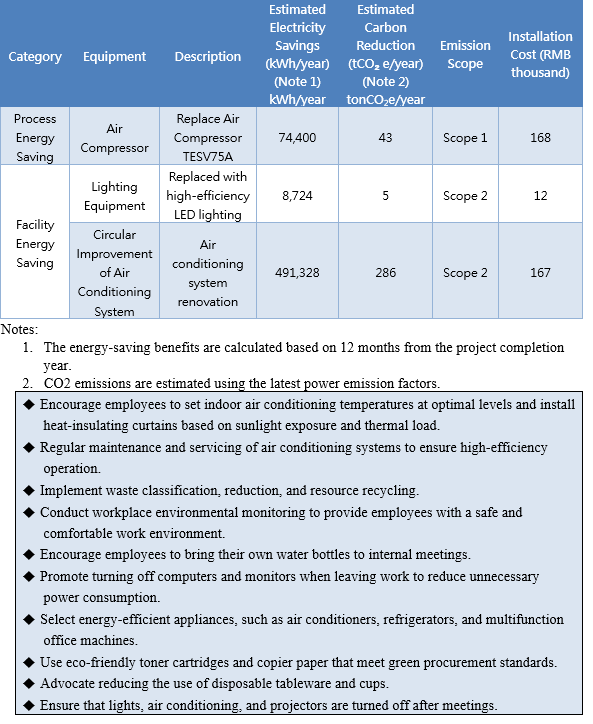
CMI has continued to advance energy efficiency within its facilities by implementing a range of energy-saving measures designed to optimize operational performance and reduce electricity consumption. In 2025, the Company completed three projects under its energy conservation and carbon reduction management program, with a total investment of RMB 347,000. These initiatives delivered electricity savings of 574,452 kWh and achieved a carbon reduction equivalent to 334 metric tons of CO2e