To identify major emission sources and formulate carbon reduction strategies, CMI calculates GHG emissions in Scopes 1, 2, and 3 per ISO 14064:2018. In 2024, Scope 1 (direct emissions) totaled 1,622.5953 metric tons of CO₂e, Scope 2 (energy indirect emissions) amounted to 7,487.8133 metric tons of CO₂e, and Scope 3 (other indirect emissions) reached 13,270.7154 metric tons of CO₂e. Among them, Scope 3 emissions from product and service usage were the highest, followed by Scope 2 emissions from purchased electricity.
2024 Greenhouse Gas Emissions
Scope of Coverage: Taiwan Headquarters and its subsidiaries —KUNSHAN COMPLEX MICRO INTERCONNECTION CO., LTD (Kunshan Flexible PCB Plant) and Yuan Yuh Electronics (Kunshan) Co., Ltd. (Kunshan Wire Harness Plant).
| Category | Unit | Taiwan HQ | Kunshan FPC | Kunshan Wire Harness | Total |
|---|---|---|---|---|---|
| Scope 1 | metric tons CO₂e | 19.0269 | 1563.6996 | 39.8688 | 1622.5953 |
| Scope 2 | metric tons CO₂e | 54.2017 | 7106.8683 | 326.7433 | 7487.8133 |
| Scope 3 | metric tons CO₂e | 123.5652 | 12186.8077 | 960.3425 | 13270.7154 |
| Scope 1 & 2 Total | metric tons CO₂e | 73.2286 | 8670.5679 | 366.6121 | 9110.4086 |
| Total Emissions | metric tons CO₂e | 196.7938 | 20857.3756 | 1326.9546 | 22381.1239 |
| Scope 1 & 2 Emission Intensity | metric tons CO₂e / NT$ million | 0.03 | 3.5564 | 0.1504 | 3.7368 |
| Scope 3 Emission Intensity | metric tons CO₂e / NT$ million | 0.0507 | 4.9987 | 0.3939 | 5.4433 |
| ISO14064-1:2018 | ||||||
|---|---|---|---|---|---|---|
| Taiwan HQ | Kunshan FPC | Kunshan Wire Harness | ||||
| Taiwan HQ-ISO-14064 | Kunshan FPC-ISO14064 | Kunshan Wire Harness-ISO-14064 |
ElectricityConsumption (Unit: GJ)
| Electricity Consumption | Head Office | Flexible PCB Factory | Wire Harness Factory | Total |
|---|---|---|---|---|
| 2023 | 355.54 | 48,521.16 | 2,391.35 | 51,268.05 |
| 2024 | 402.05 | 47,679.33 | 2,582.19 | 50,663.57 |
Water Usage (Unit: Million Liters)
| Electricity Consumption | Head Office | Flexible PCB Factory | Wire Harness Factory | Total |
|---|---|---|---|---|
| 2023 | 0.931 | 120.859 | 39.448 | 161.238 |
| 2024 | 0.879 | 119.141 | 17.497 | 137.517 |
To ensure the efficient use of water resources and environmental protection, the Company continues to implement water conservation management practices. Through process improvements, equipment optimization, and water consumption monitoring, we aim to reduce operational water usage. The Company has established an annual water reduction target for production activities, using the previous year’s total water consumption as the baseline and setting a minimum annual reduction target of 2%. Water use efficiency and improvement performance at each facility are regularly reviewed
According to the 2024 water consumption statistics, the Company’s total water withdrawal was 137.517 million liters, compared with 161.238 million liters in 2023, representing a reduction of 23.721 million liters or approximately 14.7%, which significantly exceeds the annual water-saving target (≥2%).
In the coming years, the Company will continue to maintain an annual reduction target of at least 2%, and will further reduce overall water consumption in operations by continuously improving production water efficiency and implementing water-saving initiatives.
Waste (Unit: Metric Tons)
| Factory | Project | 2023 | 2024 |
|---|---|---|---|
| Flexible PCB Factory | Total Waste | 302.04 | 294.66 |
| General Waste | 38.94 | 26.81 | |
| Hazardous Waste | 263.1 | 267.85 | |
| Wire Harness Factory | Total Waste | 4.41 | 3.28 |
| General Waste | – | – | |
| Hazardous Waste | 4.41 | 3.28 |
To minimize the environmental impact of operational activities, the Company has implemented a comprehensive waste management program that emphasizes source segregation and waste flow control. Waste is categorized into general industrial waste, hazardous waste, and recyclable valuable waste to ensure proper handling and prevent resource loss caused by improper mixing. In addition, the Company commissions government-authorized and licensed waste treatment contractors to ensure compliant disposal. We also actively seek partners with recycling technologies to convert certain waste streams into biomass fuel or other reusable products. Through waste recycling and resource recovery initiatives, the Company enhances the value of waste resources, reduces the amount of waste requiring final disposal, and achieves waste reduction while mitigating environmental impacts.
According to statistical data, the total waste generated by the flexible printed circuit board (FPC) plant in 2024 was 294.66 metric tons, slightly lower than 302.04 metric tons in 2023. The wire harness plant generated 3.28 metric tons of waste in 2024, decreasing from 4.41 metric tons in 2023. These results demonstrate the effectiveness of the Company’s ongoing waste reduction initiatives.
With respect to hazardous waste management, all hazardous waste generated by the Company’s facilities is collected and treated by government-approved and licensed waste treatment contractors in accordance with relevant regulations. The hazardous waste treatment rate reached 100%, meeting the Company’s management target.
Looking ahead, the Company will continue to optimize production processes and strengthen resource management practices to reduce waste generation, while ensuring that all hazardous waste is handled and disposed of in full compliance with applicable regulations to minimize environmental impact.
Performance Data on Wastewater Recovery, Waste Reduction, and Energy Saving Measures
Item Unit Kunshan Cmi
2023 2024
Wastewater Recovery 1,000 Tons 61.00 58.25
Note: Cmi Electronics (Kunshan) only generates domestic sewage,so no wastewater recovery is implemented.
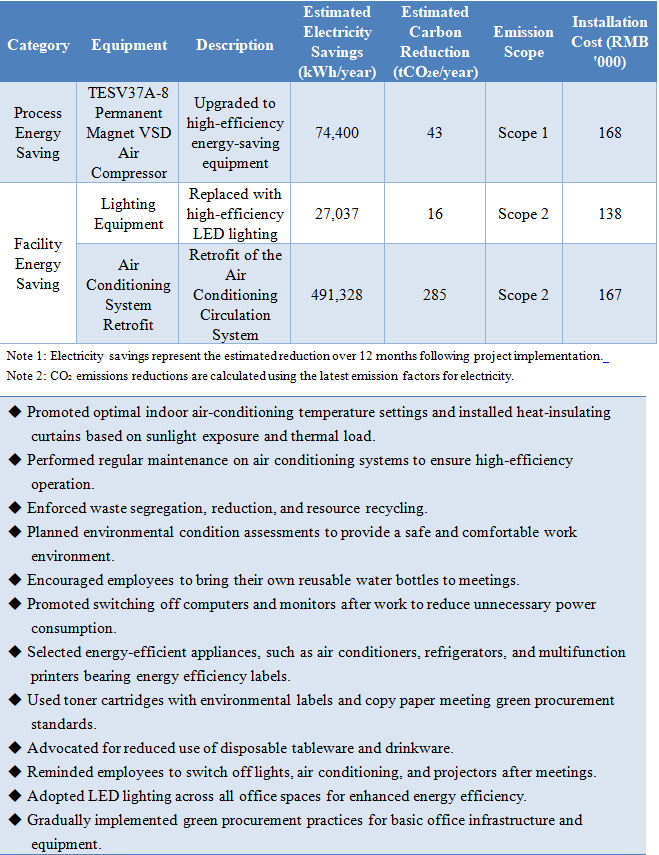
Investment in Energy-Saving Equipment
CMI has continued to advance energy efficiency within its facilities by implementing a range of energy-saving measures designed to optimize operational performance and reduce electricity consumption. In 2025, the Company completed three projects under its energy conservation and carbon reduction management program, with a total investment of RMB 473,000. These initiatives delivered electricity savings of 592,765 kWh and achieved a carbon reduction equivalent to 344 metric tons of CO2e